
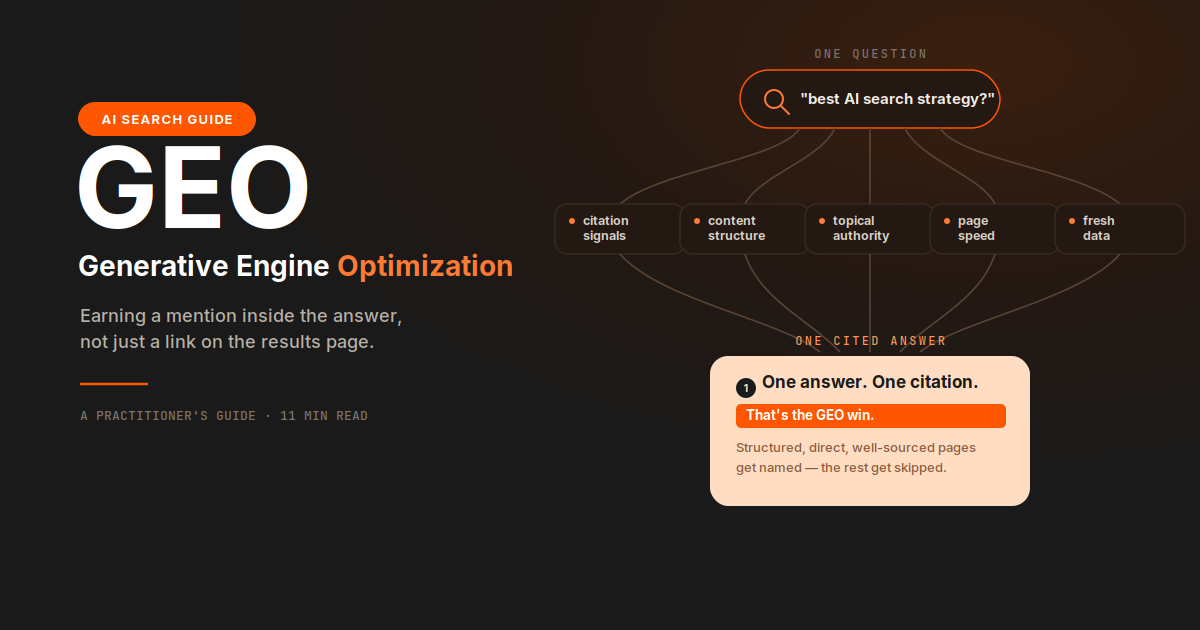
TL;DR
AI tools like ChatGPT, Gemini, and Perplexity are changing how people search, and most guides on this topic get too technical too fast. This is the plain-English version: what GEO actually is, how it differs from SEO, how AI tools decide who to cite, and a practical checklist you can start using this week.
A few years ago, "search" meant typing a few words into Google and clicking one of ten blue links. That is changing fast. Millions of people now ask ChatGPT, Gemini, or Perplexity a question and get a full answer on the spot, with maybe two or three sources named underneath it. If your brand is not one of those sources, it does not matter how well you rank on Google. You simply are not part of the conversation.
That is the problem GEO tries to solve. In this guide, we will walk through what GEO actually means, how it is different from regular SEO, how AI tools decide who to quote, and a practical list of things you can do this month to improve your odds of getting cited.
What is GEO?
Generative Engine Optimization is the practice of shaping your content so that AI search tools can find it, trust it, and use it when they write an answer. Instead of competing for a spot on a results page, you are competing for a spot inside the answer itself.
The term was coined in a 2023 research paper called "GEO: Generative Engine Optimization," written by researchers from Princeton University, Georgia Tech, IIT Delhi, and the Allen Institute for AI. The paper is one of the first academic attempts to study this problem, and it is still worth a read if you want the technical side of things. You can read the full GEO research paper on arXiv. The researchers tested different ways of writing content and measured how much each one improved a brand's chances of showing up in an AI-generated answer.
The name is still settling. Some people call this AEO, short for Answer Engine Optimization. Others just call it "AI search" or fold it into SEO altogether. Whatever you call it, the underlying job is the same: earn a mention inside an answer that a machine writes on someone's behalf.
GEO vs SEO: same family, different game
Here is the simplest way to think about it. SEO is a race to be one of ten links on a page. GEO is more like a job interview to be the one source the AI decides to quote. You can win the first and still lose the second if your page takes too long to load, buries the answer three paragraphs down, or reads like a wall of vague marketing copy.
The two are closely related, not opposites. A page that already ranks well on Google has a much better shot at being pulled into an AI answer, because both systems rely on similar signals: authority, relevance, and a clean, crawlable page. But the finish line is different.
How AI tools decide what to cite
To get better at GEO, it helps to understand roughly what is happening behind the scenes. Most AI search tools follow a similar three-step process. First, they retrieve a set of candidate pages, usually by running searches against an index like Google or Bing. Second, they read through those pages and pull out the parts that answer the question. Third, they pick a small number of sources to name in the final answer.
This is where a concept called query fan-out comes in, and it is worth understanding because it explains a lot of what looks confusing about AI search.
What is query fan-out
When you ask an AI tool a single question, it rarely searches for just that one thing. Instead, it breaks your question into smaller related questions and searches for all of them at once, then combines what it finds into one answer. Google has confirmed this is exactly how its AI Overviews and AI Mode work. In its own developer documentation on AI features, Google explains that both features may rely on query fan-out, issuing a set of related searches behind the scenes to build a fuller response. The same documentation notes that this retrieval process is grounded in Google's core search ranking systems, which is a fancy way of saying that classic SEO signals still feed the AI answer.
Search Engine Land has written extensively about this pattern too, noting that most AI-powered search tools, including AI Overviews, AI Mode, Gemini, ChatGPT, Perplexity, Copilot, and Grok, rely on some version of query fan-out to answer a prompt. So if someone asks "best running shoes for flat feet," the AI might quietly run searches for "best shoes for overpronation," "running shoe reviews 2026," and "flat feet shoe recommendations" behind the scenes, then blend the results into one clean answer.
This matters for two reasons. First, it means one piece of content can get pulled into many different conversations, not just the exact question you optimized it for. Second, it means the sub-queries you never see are often where the real opportunity sits. If you only optimize for the obvious head keyword, you miss the long tail of smaller questions the AI is actually searching behind the curtain.
Why every AI tool behaves a little differently
Here is something a lot of guides skip. Not every AI tool searches the web the same way, and that matters a lot for how you plan your GEO work.
Google's Gemini and AI Overviews pull directly from Google's own search index, since it is all built by the same company. That is the most direct path, and if you already rank well organically, you are already feeding it.
ChatGPT works differently. OpenAI does not run its own search index. Instead, it built its search feature on top of Bing, through a long-running partnership with Microsoft. If a page is not indexed by Bing, it generally will not show up as a source in ChatGPT's answers, regardless of how well it ranks on Google. That means Bing Webmaster Tools, which a lot of marketers ignore, is suddenly a lot more important than it used to be. We go deeper on the exact steps for this in our guide to SEO for ChatGPT, including why JavaScript-heavy sites often struggle to get picked up at all.
Perplexity leans heavily on live web results too, often blending its own crawling with data pulled from search APIs, and tends to favor pages that are fresh, well-structured, and easy to extract a direct answer from.
The practical takeaway is simple. You cannot optimize for "AI search" as if it were one thing. You need to think about at least three different retrieval paths: Google's own index, Bing's index, and whatever mix of sources the smaller players use. A page that is invisible on Bing can still be invisible to ChatGPT even if it ranks on page one of Google.
What actually earns a citation
Based on what we have seen work across client sites, here are the factors that tend to move the needle most, roughly in order of impact.
| Factor | Why it helps |
|---|---|
| A direct, self-contained answer near the top | The model can lift it cleanly without needing to interpret a long lead-in |
| Real numbers, facts, and comparisons | Specific data gets quoted, vague opinion gets skipped |
| Fast page load and easy crawl access | If a bot cannot fetch the page quickly, it cannot cite it |
| Simple, clear writing | Short sentences and plain words are easier for a model to parse correctly |
| Strong topical authority | Being consistently named as an expert on a subject builds trust signals over time |
| Mentions on other trusted sites | Reviews, forum threads, and roundup articles that mention your brand feed the same pool of information the AI draws from |
| Structured data and clean HTML | Schema markup like FAQPage and Article helps machines understand what your page is actually about |
A quick note on AI Overviews specifically
Google's AI Overviews tend to reward the same signals, just sharpened. Put the direct answer to a likely question in the first sentence of a section, support it with a number or short table, and make sure the page is fast and simple to crawl. AI Overviews tend to draw from pages that already rank for the smaller sub-questions Google fans out to, so ranking organically for those long-tail questions is still step one.
A practical GEO checklist you can start this week
You do not need a huge budget to start. Here is a simple, ordered list of things worth doing.
Move your best answer higher up
Do not bury the useful part under three paragraphs of introduction. Lead with the answer, then explain it.
Cut anything that adds no information
Long, philosophical intros and vague filler do not help a reader and they do not help a crawler either.
Add real numbers wherever you can
Tables, statistics, and clear comparisons are far more citable than opinion or generic advice.
Check page speed for bots, not just users
A slow server can quietly stop AI crawlers from reading your page in time to include it in an answer. Our Website SEO Checker helps you spot issues.
Get indexed on Bing, not just Google
The single most overlooked step for ChatGPT visibility. Claim your site in Bing Webmaster Tools and watch how it is crawled.
Add schema markup
FAQPage, Article, and Organization schema help machines understand your content faster. Build it with our Schema Markup Builder.
Earn honest mentions where buyers hang out
Reddit threads, comparison articles, and review sites feed the same pool AI tools pull from. A few genuine mentions beat a dozen thin ones.
Upgrade listicles that already mention you
If a publisher lists your brand with one throwaway line, a fuller mention there can directly translate into more citations.
Want a GEO plan built for your site?
Our team gets brands found and cited across Google AI Overviews, ChatGPT, and Perplexity.
Book a Free Strategy CallHow to actually measure GEO
You cannot improve something you are not tracking. A simple measurement stack looks like this.
- Track your citations directly. Manually test a set of buyer questions across ChatGPT, Gemini, and Perplexity every few weeks and note whether you show up.
- Watch Bing Webmaster Tools. Since ChatGPT and several other assistants lean on Bing's index, this becomes a genuinely useful early warning system, not just a forgotten dashboard.
- Check GA4 referral traffic. Filter for traffic coming from chatgpt.com, perplexity.ai, and similar domains to see which pages are actually getting used and clicked through.
- Study your winning pages and repeat the pattern. Once you find pages that are getting cited, look closely at their structure, length, and format, then apply the same shape to other pages on your site.
You are writing for machines and people now, not just people
This is the mindset shift that ties everything together. GEO is not only about ranking for a human reader anymore. Increasingly, it is about being read by an AI agent on that reader's behalf. Zero-click search keeps growing, which means fewer people are visiting your site directly. At the same time, more automated systems are fetching, reading, and quoting your pages inside someone else's answer.
So write for both. A person landing on your page should find it clear, useful, and easy to scan. A bot reading the same page should find it fast to load, simple to parse, and full of specific facts worth repeating. Get both right, and you are in a good position no matter how search keeps changing.
FAQ
Is GEO just SEO with a new name?
Not exactly. They share a lot of the same foundations, like page speed, authority, and clean structure. But GEO is optimizing for being quoted inside an AI-written answer, not for ranking a page on a results list, and the type of content that wins looks a little different.
Does regular SEO still matter if I care about GEO?
Yes, a lot. AI tools fan out your question into smaller searches run against Google or Bing, so being visible and trusted on those platforms is still what puts you in the pool of pages an AI can even consider citing.
How do I get cited by ChatGPT specifically?
Make sure your site is properly indexed on Bing first, since that is what ChatGPT's search feature is built on. Then give it something worth quoting: a clear, direct answer near the top of the page, backed by real facts, on a page that loads fast.
Which AI tools should I focus on first?
Start with wherever your buyers are already asking questions. For most businesses that means Google's AI Overviews, ChatGPT, and Perplexity. The core habits that help with these three tend to help everywhere else too.
How long does GEO take to show results?
Some citation gains can show up within a few weeks once you fix structure and add real facts to a page. Building the kind of topical authority that keeps you cited consistently takes longer, usually a few months of steady, focused work.
How do I know if GEO is actually working?
Track citation frequency across a fixed set of buyer questions over time, and watch your AI referral traffic in GA4. Rankings alone will not tell you the full story anymore.
Final word
Search is shifting from links to answers, and increasingly from people to agents reading on their behalf. If you want help getting your brand found and cited in this new layer of search, talk to our SEO team about what a GEO plan could look like for your site.
